Essays
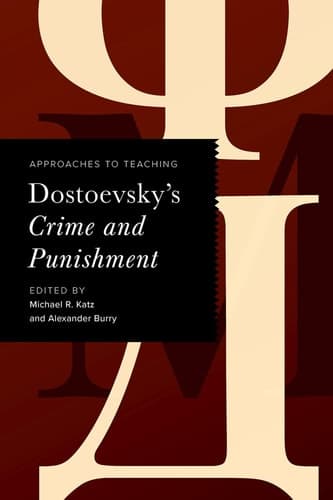
Approaches to Teaching Dostoevsky's Crime and Punishment
2022·210 pages
A guide to teaching Dostoevsky's Crime and Punishment, exploring themes, scenes, and cultural context.
Owned
No reviews yet
Owned
A guide to teaching Dostoevsky's Crime and Punishment, exploring themes, scenes, and cultural context.
About
Details
Recounting the murder of an elderly woman by a student expelled from university, Crime and Punishment is a psychological and political novel that portrays the strains on Russian society in the middle of the nineteenth century. Its protagonist, Raskolnikov, moves in a world of dire poverty, disillusionment, radicalism, and nihilism interwoven with religious faith and utopianism. In Dostoevsky's innovative style, which he called fantastic realism , the narrator frequently reports from within the p...
What's Inside
will contain mild spoilers
Sexual content
AI
Minor references to relationships in the context of the novel's analysis.
Violence & gore
AI
Moderate discussion of murder and violence as central to the novel's plot.
Profanity
AI
No evidence found in available sources.
Substance use
AI
Brief mentions of alcoholism in the context of character analysis.
LGBTQ+ Rep.
AI
No evidence found in available sources.
Religious content
AI
Major focus on Orthodox Christianity as a theme in Dostoevsky's work.
Magic & witchcraft
AI
No fantasy elements present.
Occult / demonology
AI
No real-world occult content present.
Political content
AI
Strong focus on social justice, radicalism, and nihilism in Russian society.
Self-harm / suicide
AI
Minor references to despair and ideation in character discussions.
Abuse & suffering
AI
Moderate analysis of poverty, coercion, and systemic suffering in the novel.
Other
AI
No information found.