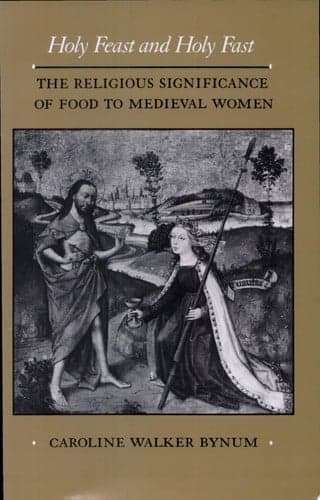
Holy Feast and Holy Fast: The Religious Significance of Food to Medieval Women
1987·464 pages
Scholarly study of food, fasting, and eucharistic devotion in the religious lives of medieval European women, 1200-1500.
Owned
No reviews yet
Owned
Scholarly study of food, fasting, and eucharistic devotion in the religious lives of medieval European women, 1200-1500.
About
Details
In the period between 1200 and 1500 in western Europe, a number of religious women gained widespread veneration and even canonization as saints for their extraordinary devotion to the Christian eucharist, supernatural multiplications of food and drink, and miracles of bodily manipulation, including stigmata and inedia (living without eating). The occurrence of such phenomena sheds much light on the nature of medieval society and medieval religion. It also forms a chapter in the history of women....
What's Inside
will contain mild spoilers
Sexual content
AI
No romantic or sexual content depicted.
Violence & gore
AI
Historical accounts of stigmata and bodily mortification in saints' lives.
Profanity
AI
No profanity or strong language.
Substance use
AI
No substance use depicted.
LGBTQ+ Rep.
AI
No LGBTQ+ representation or themes.
Religious content
AI
Central focus on medieval Christian eucharist devotion, fasting, saints, and piety.
Magic & witchcraft
AI
No fantasy magic or witchcraft elements.
Occult / demonology
AI
No occult or demonological content.
Political content
AI
Explores gender roles and women's agency via feminist and anthropological analysis.
Self-harm / suicide
AI
Historical religious fasting, inedia, and ascetic bodily practices.
Abuse & suffering
AI
Accounts of physical suffering through fasting and stigmata in saints' lives.
Other
AI
No information found