Essays
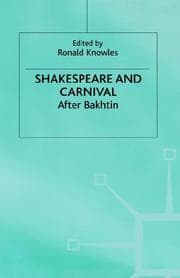
Shakespeare and Carnival
1998·232 pages
Scholarly essays applying Bakhtin’s carnivalesque theory to Shakespeare, exploring festival, the grotesque body, and festive culture.
Owned
No reviews yet
Owned
Scholarly essays applying Bakhtin’s carnivalesque theory to Shakespeare, exploring festival, the grotesque body, and festive culture.
About
Details
This book is the first collection to assess a range of Shakespeare's plays in relation to the theory of the carnivalesque. Contributors re-historicize the carnivalesque in different ways, offering developed applications, or critiques, of Bakhtin's thought as expounded in Rabelais and His World Following an introductory overview of Bakhtin's ideas, the grotesque body looms large in such figures as Jack Cade, Falstaff and Cardinal Wolsey. Elsewhere the Dance of Death jostles with folk custom and c...
What's Inside
will contain mild spoilers
Sexual content
AI
Recurring scholarly discussion of bawdy comedy, the body, and sexual carnival motifs
Violence & gore
AI
Analysis of death, rebellion, and Dance of Death motifs across several plays
Profanity
AI
Occasional discussion of Shakespearean bawdy and coarse festive language
Substance use
AI
Brief treatment of feasting, drinking, and Falstaffian excess in carnival context
LGBTQ+ Rep.
AI
No evidence found in available sources
Religious content
AI
Recurring themes: Puritanism, clergy figures, Erasmus, and religious roots of carnival
Magic & witchcraft
AI
Brief discussion of fairy and festive magic in A Midsummer Night’s Dream
Occult / demonology
AI
No evidence found in available sources
Political content
AI
Central focus on hierarchy inversion, class, carnival politics, and social order
Self-harm / suicide
AI
Passing analytical reference via Hamlet and Romeo and Juliet death themes
Abuse & suffering
AI
Referenced historical cruelty and rebellion (e.g. Jack Cade) in critical context
Other
AI
No information found